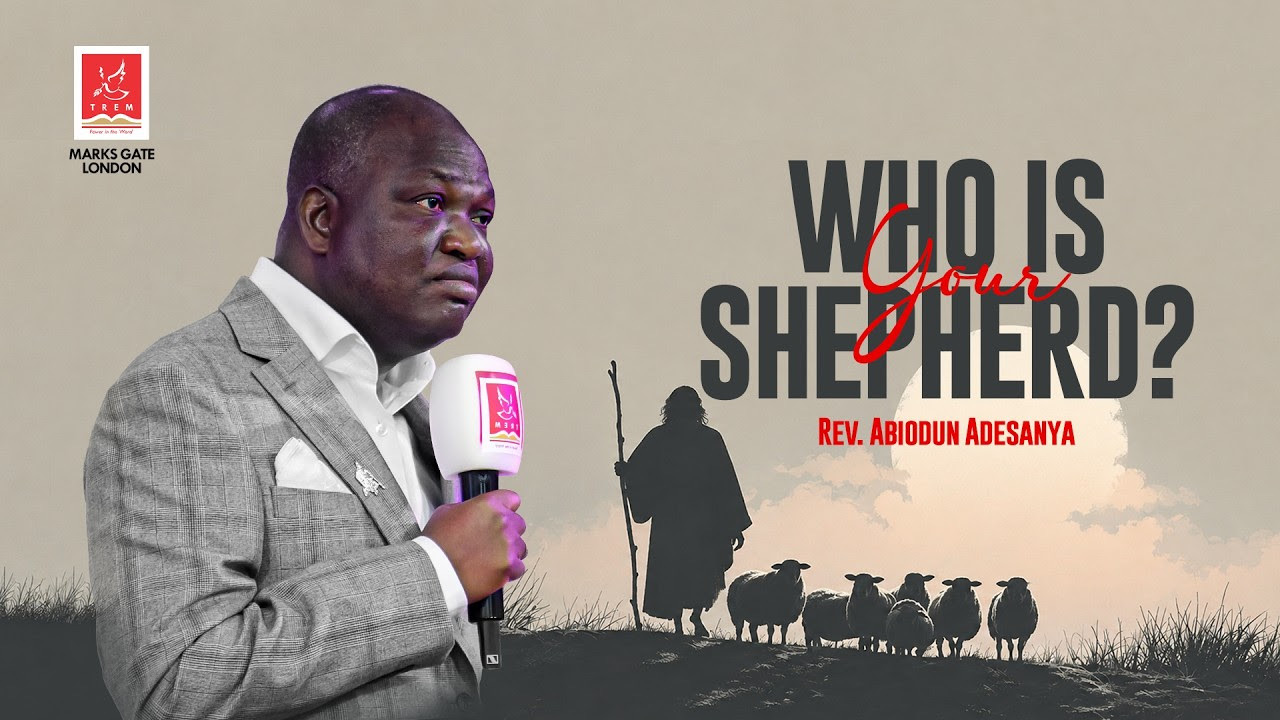
Who is your Shepherd | Rev. Abiodun Adesanya

Sermon Notes Understanding the Kind of Shepherd We Are Called to BeMonthly Theme: Jehovah Rohi — The Lord Our ShepherdMain Texts: Matthew 28:19–20, Mark 16:15–18, Psalm 23Supporting Texts: Genesis 30:27–30, Jonah 1:1–16, John 12:3–6, Matthew 26:21–25, Genesis 37, Genesis 39, Genesis 45, John 6:35, John 6:51, John 14:1–31. INTRODUCTION — SHEPHERDS AND THE SHEPHERDThis month, …

│
│
pray, grow and share with us

Listen to Audio Version:

00:00
00:00

Sermon Notes

Understanding the Kind of Shepherd We Are Called to Be

Monthly Theme: Jehovah Rohi — The Lord Our Shepherd
Main Texts: Matthew 28:19–20, Mark 16:15–18, Psalm 23
Supporting Texts: Genesis 30:27–30, Jonah 1:1–16, John 12:3–6, Matthew 26:21–25, Genesis 37, Genesis 39, Genesis 45, John 6:35, John 6:51, John 14:1–3

1. INTRODUCTION — SHEPHERDS AND THE SHEPHERD

This month, we have been looking at Jehovah Rohi — the Lord our Shepherd.

God has been speaking to us about what it means to have Him as our Shepherd, but this message takes the conversation further.

The subject is:

“Shepherds and the Shepherd.”

The Shepherd is Jesus Christ Himself.

But throughout life, we will also encounter human shepherds — people God places around us to guide, instruct, lead, teach, mentor and direct us.

They may appear:

  • in our families
  • in school
  • in the workplace
  • in ministry
  • in business
  • in our communities
  • in our relationships
  • in positions of leadership

And at different points in life, we too will become shepherds.

A father can be a shepherd.

A mother can be a shepherd.

A teacher can be a shepherd.

A supervisor can be a shepherd.

A pastor can be a shepherd.

A ministry leader can be a shepherd.

A class representative can be a shepherd.

Anyone entrusted with people, influence, responsibility or direction is functioning in some form as a shepherd.

The important question is:

What kind of shepherd are you?

2. EVERY BELIEVER IS CALLED TO SHEPHERD

Jesus did not call believers merely to receive.

He called us to go.

Matthew 28:19–20

Jesus said:

“Go ye therefore, and teach all nations…”

He instructed believers to:

  • go
  • teach
  • baptise
  • disciple
  • reproduce what He had taught them

In other words:

Jesus trained shepherds and then sent them out to shepherd others.

He said:

“…teaching them to observe all things whatsoever I have commanded you…”

The instruction was simple:

“Teach others what I have taught you.”

And Jesus gave this assurance:

“Lo, I am with you alway, even unto the end of the world.”

There is therefore a powerful relationship between obedient service and the conscious experience of God’s presence.

3. THE GREAT COMMISSION IS A SHEPHERDING ASSIGNMENT

Mark 16:15

Jesus said:

“Go ye into all the world, and preach the gospel to every creature.”

Our responsibility is to preach.

Our responsibility is to speak the Word.

Our responsibility is to represent Christ.

It is ultimately God who changes hearts.

We cannot force anyone into salvation.

We simply remain faithful to the assignment.

4. THE SIGNS OF A BELIEVER

Mark 16:17–18

Jesus spoke about signs following those who believe.

The passage speaks of:

  • authority over demons
  • supernatural protection
  • speaking in new tongues
  • laying hands on the sick
  • healing
  • divine preservation

This reminds us that Christianity is not simply an intellectual confession.

The life of a believer should demonstrate the reality of Christ.

We must believe the promises of God.

We must walk in faith.

We must pray with faith.

We must trust God for healing, deliverance and supernatural intervention.

Declaration

Place your hand upon yourself and declare:

I am a believer.

I belong to Jesus.

I walk in divine strength.

I walk in divine protection.

Every infirmity in my body must bow to the authority of Jesus Christ.

I receive healing and strength in Jesus’ name.

Amen.

5. FOUR TYPES OF “J” SHEPHERDS

We will examine four different types of shepherds represented by four biblical personalities.

1. Jacob — The Multiplier

2. Jonah — The Complainant

3. Judas — The Selfish Shepherd

4. Joseph — The Caring Organiser

The question is not simply:

“Which one have I encountered?”

The more important question is:

“Which one am I becoming?”

TYPE 1: JACOB THE SHEPHERD

THE MULTIPLIER

Genesis 30:27–30

Jacob represents a shepherd who multiplies whatever is placed in his care.

The Jacob-type shepherd is:

  • diligent
  • productive
  • prayerful
  • dependable
  • innovative
  • faithful
  • calm under responsibility
  • fruitful

He does not need constant supervision.

He does not require somebody to stand over him before he works.

He understands the assignment and carries it out faithfully.

6. JACOB LEADS BY EXAMPLE

The Jacob-type shepherd does not simply say:

“Do what I say.”

He says:

“Do what I do.”

His life becomes an example.

His character reflects his instruction.

His behaviour reinforces his teaching.

His results demonstrate his diligence.

7. JACOB DOES NOT DO EYE SERVICE

Jacob-type shepherds work whether somebody is watching or not.

Their commitment does not depend on:

  • the pastor being present
  • the bishop being present
  • the manager being present
  • praise from others
  • applause
  • recognition

Their work is consistent.

It is simply business as usual.

They understand responsibility.

8. JACOB MULTIPLIES WHAT IS PLACED IN HIS HAND

Jacob served Laban for many years.

Despite unfair treatment and changing wages, Jacob remained productive.

Genesis 30:27

Laban eventually confessed:

“I have learned by experience that the LORD hath blessed me for thy sake.”

What a testimony.

Laban recognised:

“My life became better because you came into it.”

That is the mark of a good shepherd.

The question is:

Do things improve because you are there?

Does the ministry improve?

Does the company improve?

Does the family improve?

Does the department improve?

Does the church improve?

Does the team improve?

9. HONOUR YOUR JACOBS

If God has placed Jacob-type people around you, do not take them for granted.

Appreciate them.

Encourage them.

Support them.

Honour them.

Reward them fairly.

Jacob eventually said:

Genesis 30:29–30

“Thou knowest how I have served thee, and how thy cattle was with me…”

He reminded Laban that there had been tremendous increase under his care.

But then Jacob asked an important question:

“And now, when shall I provide for mine own house also?”

This is a reminder that loyal people should not be exploited.

Encourage people while they are still with you.

Give them their flowers while they can still smell them.

Tell people:

“Thank you.”

“I appreciate you.”

“You are doing well.”

10. CHARACTERISTICS OF THE JACOB SHEPHERD

Jacob-type shepherds are:

  • multipliers
  • builders
  • team players
  • reconcilers
  • innovators
  • diligent workers
  • solution-minded people
  • consistent
  • productive
  • trustworthy

If you have one, cherish them.

And if you are one:

Remain faithful, even when people fail to appreciate you.

God sees your labour.

TYPE 2: JONAH THE SHEPHERD

THE COMPLAINANT

Jonah 1:1–16

Jonah represents another type of shepherd.

This shepherd may be present physically but absent emotionally and spiritually.

The Jonah-type shepherd:

  • complains
  • resists responsibility
  • lacks passion
  • becomes disengaged
  • creates frustration
  • contributes negativity
  • avoids accountability
  • sometimes knows the solution but remains silent

11. JONAH WAS SENT — BUT WENT THE OTHER WAY

God gave Jonah an assignment.

Jonah 1:2

“Arise, go to Nineveh…”

But instead of obeying, Jonah went in the opposite direction.

He was called to shepherd people.

But he resisted the assignment.

This teaches us:

You can occupy a position without carrying the heart of the assignment.

12. THE JONAH SHEPHERD CAN BE PRESENT BUT ABSENT

While the storm was raging, the sailors were fighting desperately to survive.

They prayed.

They threw cargo overboard.

They exhausted themselves trying to save the ship.

But Jonah was sleeping.

Jonah 1:5

The man connected to the problem was sleeping while everyone else was losing resources.

That is dangerous leadership.

The Jonah-type shepherd may:

  • see a problem
  • know the cause
  • know the solution
  • yet remain silent

And while he is silent, others suffer.

13. JONAH KNEW THE ANSWER

Eventually, Jonah admitted:

Jonah 1:12

“Take me up, and cast me forth into the sea; so shall the sea be calm unto you…”

He knew the storm was connected to him.

Yet he allowed the sailors to struggle first.

He allowed resources to be wasted.

This is why leaders must never become indifferent.

A shepherd must care about the cost other people are paying.

14. CHARACTERISTICS OF THE JONAH SHEPHERD

The Jonah-type shepherd may be:

  • reluctant
  • complaining
  • arrogant
  • self-righteous
  • uncooperative
  • emotionally withdrawn
  • disobedient
  • inflexible
  • unconcerned about the flock

Sometimes their attitude is:

“My way or nothing.”

They may not care what happens if things are not done the way they want.

15. DO NOT ALLOW A JONAH SPIRIT TO DAMAGE THE FLOCK

The message here is not hatred toward people.

Jonah still belonged to God.

But destructive attitudes must not be allowed to destroy the work.

Leadership requires wisdom.

Correction may be necessary.

Accountability may be necessary.

Removal from responsibility may sometimes be necessary.

Because:

One disengaged shepherd can damage an entire flock.

TYPE 3: JUDAS THE SHEPHERD

THE SELFISH SHEPHERD

John 12:3–6

Judas represents the shepherd who serves primarily for personal gain.

The Judas-type shepherd thinks:

“What is in this for me?”

His motivation is self-interest.

His service depends on personal benefit.

His loyalty lasts as long as things are favourable.

16. JUDAS DID NOT BECOME JUDAS IN ONE DAY

Judas did not suddenly become corrupt on the day he betrayed Jesus.

His character had been developing.

John tells us that Judas had responsibility for the money bag.

But he had already become dishonest.

John 12:6

Scripture says:

“…he was a thief, and had the bag…”

This teaches us:

Major failure often begins with small tolerated compromises.

17. THE JUDAS SHEPHERD APPEARS CONCERNED

When Mary poured expensive perfume on Jesus, Judas objected.

He asked why the perfume had not been sold and the money given to the poor.

It sounded spiritual.

It sounded compassionate.

But Scripture revealed his true motive.

He was not concerned about the poor.

He was concerned about the money.

This is important.

Not every spiritual-sounding statement comes from a spiritual motive.

God examines the heart.

18. THE DANGER OF SELFISH SERVICE

The Judas-type shepherd may serve because of:

  • money
  • position
  • recognition
  • influence
  • personal advantage
  • titles
  • access
  • status

But service to God must not be built around:

me, myself and I.

Do not say:

“If they don’t recognise me, I won’t serve.”

“If they don’t make me the leader, I’m leaving.”

“If they don’t take my opinion, I’m withdrawing.”

That is a dangerous path.

19. JUDAS BETRAYED WHAT HE WAS CALLED TO PROTECT

Matthew 26:21–25

Jesus warned that someone at the table would betray Him.

Judas even asked:

“Master, is it I?”

Jesus answered him.

Yet Judas continued on the same path.

This shows the destructive power of unchecked selfishness.

When personal gain becomes more important than purpose, betrayal becomes possible.

20. DO NOT LET MONEY CONTROL YOU

Money is useful.

Money is necessary.

But money must never become your master.

Do not allow money to determine:

  • your integrity
  • your loyalty
  • your service
  • your obedience
  • your relationships
  • your commitment to God

Serve God because He is God.

Not because of what you can get.

TYPE 4: JOSEPH THE SHEPHERD

THE CARING ORGANISER

Joseph represents a different kind of shepherd.

He was:

  • organised
  • compassionate
  • truthful
  • trustworthy
  • God-fearing
  • dependable
  • wise
  • discreet
  • productive
  • selfless

Joseph carried grace wherever he went.

21. JOSEPH FEARED GOD MORE THAN MAN

Genesis 39

When Potiphar’s wife tried to seduce Joseph, Joseph refused.

His decision was not simply:

“I don’t want my master to find out.”

His deeper conviction was:

“How can I do this great wickedness and sin against God?”

Joseph’s loyalty came from his relationship with God.

That is the difference.

The Joseph-type shepherd does not only behave well when people are watching.

He behaves well because God is watching.

22. JOSEPH CARRIED GRACE INTO EVERY ENVIRONMENT

Joseph experienced different seasons.

He was:

  • a son
  • a shepherd
  • a slave
  • a servant
  • a prisoner
  • an administrator
  • a ruler

Yet the grace of God followed him everywhere.

His location changed.

His circumstances changed.

His position changed.

But what he carried did not change.

The Joseph shepherd carries excellence into every environment.

23. JOSEPH COULD BE TRUSTED

Potiphar trusted Joseph.

The prison keeper trusted Joseph.

Pharaoh trusted Joseph.

Why?

Because Joseph demonstrated integrity.

He could be trusted with:

  • responsibility
  • information
  • resources
  • people
  • authority

A great shepherd must be trustworthy.

24. JOSEPH KNEW HOW TO KEEP CONFIDENCE

In prison, Joseph interpreted the dreams of the butler and the baker.

He did not turn other people’s private matters into gossip.

He did not use information carelessly.

Good shepherds protect what is entrusted to them.

Some people cannot be trusted with information.

A Joseph shepherd can.

25. JOSEPH SERVED EVEN WHEN HE WAS FORGOTTEN

Joseph helped the butler.

He asked:

“Remember me.”

But the butler forgot Joseph for two years.

Joseph could have become bitter.

He could have complained.

He could have said:

“After everything I did for him!”

But he continued.

And when God’s time came, Joseph was remembered.

Your reward does not always come through the person you helped.

God can reward you Himself.

26. JOSEPH CARED ABOUT PEOPLE

Joseph had reason to become bitter toward his brothers.

They hated him.

They rejected him.

They sold him.

But later, when Joseph had power, he did not use that power to destroy them.

He preserved them.

This is the heart of a shepherd.

A shepherd does not use power to punish people unnecessarily.

A shepherd uses influence to preserve, restore and build.

27. JOSEPH WOULD RATHER SUFFER THAN BETRAY TRUST

Potiphar had placed everything in Joseph’s hands except his wife.

Joseph understood:

“I will not abuse the trust given to me.”

That is leadership.

That is integrity.

Sometimes doing the right thing has a cost.

Joseph paid that cost.

But God vindicated him.

28. CHARACTERISTICS OF THE JOSEPH SHEPHERD

Joseph-type shepherds:

  • fear God
  • care about people
  • organise well
  • protect confidential information
  • remain faithful under pressure
  • resist temptation
  • forgive
  • carry grace
  • build systems
  • solve problems
  • preserve people
  • serve without bitterness

May God give us shepherds who care.

And may God make us such shepherds.

JESUS — THE GREAT AND GOOD SHEPHERD

After examining Jacob, Jonah, Judas and Joseph, we come to the greatest Shepherd of all.

Jesus Christ.

Jacob may multiply.

Joseph may organise.

But Jesus is the perfect Shepherd.

29. JESUS IS THE WAY

Jesus said:

John 14

“I am the way, the truth, and the life.”

He does not lead people into confusion.

He leads them to the Father.

30. JESUS CALLS US TO FOLLOW HIM

Jesus said:

“Follow me, and I will make you fishers of men.”

The Shepherd does not simply call us to follow.

He transforms us while we follow.

When you follow Jesus, He changes what you become.

31. JESUS PREPARES THE WAY AHEAD

John 14:2–3

Jesus said:

“In my Father’s house are many mansions…”

He said:

“I go to prepare a place for you.”

Jesus is the Shepherd who goes ahead.

He knows where He is taking His sheep.

He does not lead blindly.

He has already prepared the destination.

32. JESUS IS THE BREAD OF LIFE

John 6:35

Jesus said:

“I am the bread of life: he that cometh to me shall never hunger…”

And in John 6:51:

“I am the living bread which came down from heaven…”

The Good Shepherd does not merely direct His sheep.

He sustains them.

He feeds them.

He strengthens them.

He gives them life.

33. JESUS WILL NEVER ABANDON HIS SHEEP

Jacob was a good shepherd.

Joseph was a good shepherd.

But Jesus is greater than them all.

He will never leave you.

He will never forsake you.

He knows:

  • where you are
  • what you are facing
  • what you are thinking
  • what tomorrow looks like
  • what your journey requires
  • what you need before you ask

You can trust the Shepherd.

34. “THE LORD IS MY SHEPHERD”

Psalm 23:1

David said:

“The LORD is my shepherd; I shall not want.”

David’s confidence was not in his circumstances.

His confidence was in his Shepherd.

He knew:

If the Lord is leading me, I will have what I need.

35. GOODNESS AND MERCY WILL FOLLOW ME

Psalm 23:6

David concluded:

“Surely goodness and mercy shall follow me all the days of my life…”

Notice the confidence:

“Surely.”

Not maybe.

Not perhaps.

Not occasionally.

Surely.

David knew that because God was his Shepherd, goodness and mercy would accompany his life.

36. STAY WITH THE SHEPHERD

David continued:

“…and I will dwell in the house of the LORD for ever.”

His confidence was connected to his commitment.

He was saying:

“I will continue to make the Lord my Shepherd.”

And as long as God remains your Shepherd, you can face the future with confidence.

37. ENCOURAGEMENT TO THE FLOCK

You may not know what tomorrow holds.

You may be going through a difficult season.

You may be confused.

You may be discouraged.

You may be facing circumstances you do not understand.

But the Good Shepherd understands your journey.

He knows the end from the beginning.

He will not abandon His flock.

He will come through for you.

May the goodness and mercy of God continue to follow you all the days of your life.

In Jesus’ name. Amen.

ALTAR CALL / REFLECTION

WHAT KIND OF SHEPHERD ARE YOU?

Take a moment to reflect.

Ask yourself:

Am I a Jacob?

Do I multiply what God places in my hands?

Am I becoming a Jonah?

Am I complaining, resisting or disengaging from responsibility?

Is there any Judas tendency in me?

Has service become about money, recognition, position or self-interest?

Am I becoming a Joseph?

Can God trust me with people, responsibility and information?

And above all:

Am I becoming like Jesus?

38. PERSONAL PRAYER

Pray:

Father, help me.

Help me to be a faithful shepherd.

Help me to care about the people You place in my life.

Help me to lead with integrity.

Help me to serve without selfishness.

Help me to multiply what You put in my hands.

Help me to remain faithful even when I am not recognised.

Help me to reject the attitude of Jonah.

Deliver me from the selfishness of Judas.

Give me the diligence of Jacob.

Give me the integrity and compassion of Joseph.

But above all:

Make me more like Jesus, the Good Shepherd.

39. CLOSING PRAYER

Father, we thank You for Your sons and daughters.

Thank You for Your Word.

Your Word says that if we are willing and obedient, we shall eat the good of the land.

We declare that we are willing.

We declare that we are obedient.

Give us grace to obey the Great Commission.

Help us to go into the world.

Help us to preach Your Word.

Help us to disciple people.

Help us to represent Christ faithfully.

And as we go, let the signs of Your presence accompany us.

Let Your power be revealed.

Let lives be transformed.

Let the sick receive healing.

Let the oppressed receive deliverance.

Let Your people walk in divine preservation.

Where there is sickness, let healing come.

Where there is weakness, release strength.

Where there is discouragement, release hope.

Where there is confusion, release direction.

Thank You for Your goodness.

Thank You for Your mercy.

Thank You because Your goodness and mercy shall follow us all the days of our lives.

And we shall dwell in the house of the Lord forever.

In Jesus’ name we have prayed.

Amen.

KEY TAKEAWAY

Every believer is called to shepherd somebody.

The issue is not whether you will influence people.

The issue is:

What kind of influence will you have?

Be a Jacob who multiplies.

Be a Joseph who cares and can be trusted.

Reject the disengagement of Jonah.

Reject the selfishness of Judas.

And above all:

Follow Jesus until you begin to shepherd like Jesus.

“The LORD is my shepherd; I shall not want.” — Psalm 23:1

Share this Sermon:

Related Sermons