THE MEDIATOR KEY SCRIPTURE
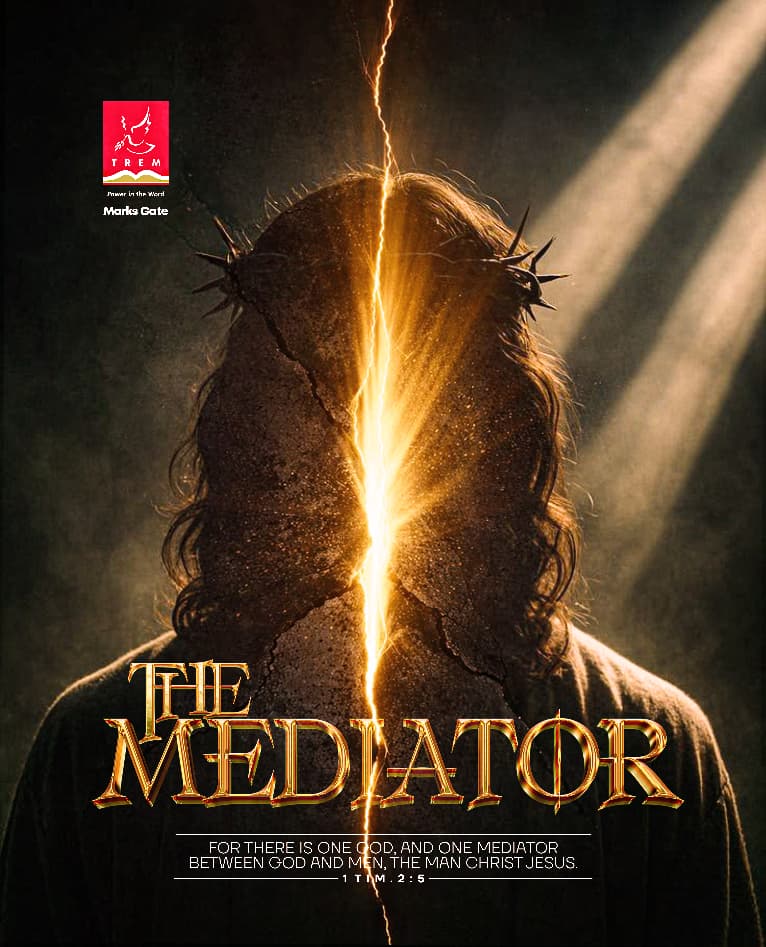
“For, There is one God and one Mediator who can reconcile God and humanity—the man Christ Jesus.” (1 Timothy 2:5 NLT)
THE NEED FOR THE MEDIATOR
The Bible clearly states that all humans have sinned and are separated from God. Our sin creates a separation between us and our Holy God. Hence the need for the Mediator to bridge this gap, someone who can reconcile us with God.
The scripture makes this clear in Romans 3:23-24: “for all have sinned, and come short of the glory of God; being justified freely by his grace through the redemption that is in Christ Jesus:” (KJV)
Sin is not without consequences. Romans 6:23 spells out the repercussions:
“For the wages of sin is death; but the gift of God is eternal life through Jesus Christ our Lord.” (KJV)
Jesus is the escape route. He himself makes this clear in John 3:3: “Jesus replied, “Very truly I tell you, no one can see the kingdom of God unless they are born again.”” (NIV)
What does it mean to be born again?
John 1:12–13 indicates that being “born again” also carries the idea of becoming “children of God” through trust in the name of Jesus Christ.
Jesus is uniquely qualified to be our Mediator because He is both fully God and fully man. As God, He has the authority and power to forgive sins. As man, He understands our weaknesses and intercedes on our behalf. He gave Himself as a ransom, paying the price for our sins, thus reconciling us with God.
BOTH PARTIES AGREE TO MEDIATION
Whether we know it or not, we are beneficiaries of Christ’s mediation between us and God.
No mediation is automatic. Parties in the conflict have to agree to be mediated. And they must agree to be bound by the outcome of the mediation.
God agreed to be mediated with man by providing Jesus. John 3:16- 17 reads: “For God so loved the world, that he gave his only begotten Son, that whosoever believeth in him should not perish, but have everlasting life. For God sent not his Son into the world to condemn the world; but that the world through him might be saved.” (KJV)
He offered us the olive branch as he beckoned: “Come unto me, all ye that labour and are heavy laden, and I will give you rest.” (Matthew 11:28 KJV)
Man also agreed to be mediated with God by accepting Jesus as our Lord and Saviour: “That if thou shalt confess with thy mouth the Lord Jesus, and shalt believe in thine heart that God hath raised him from the dead, thou shalt be saved.” (Romans 10:9 KJV)
The scripture says:
“For Christ has already accomplished the purpose for which the law was given. As a result, all who believe in him are made right with God.” (Romans 10:4 NLT)
Looking at the terms of the mediation, there is no doubt that God bent over backwards to accommodate mankind.
JESUS AS THE MEDIATOR
Jesus Christ is the mediator of the New Covenant. This concept is central to the New Testament.
Hebrews 9:15 reads:
“That is why he is the one who mediates a new covenant between God and people, so that all who are called can receive the eternal inheritance God has promised them. For Christ died to set them free from the penalty of the sins they had committed under that first covenant.” (NLT)
Let us also look at 1 Timothy 2:5:
“For there is one God, and one mediator between God and men, the man Christ Jesus;” (KJV)
Hebrews 12:24 says: “and to Jesus, the mediator of a new covenant, and to the sprinkled blood, which speaks better than the blood of Abel.” (KJV)
This leaves no one in doubt as to who the Mediator is – Jesus Christ.
As the Mediator, Jesus fulfils several key roles:
Intercessor: Jesus intercedes on behalf of humanity before God. Through His sacrificial death and resurrection, He bridges the gap between a holy God and sinful humanity, making reconciliation possible. High Priest: Jesus serves as the high priest who offers Himself as the perfect sacrifice for sin. His role as a high priest is eternal and superior to the Levitical priesthood of the Old Covenant (Hebrews 4:14-16, 7:23-28).
To appropriate the benefits of the New Covenant, it is vitally important to accept the Mediator as Lord and Saviour. The sinners prayer that results in salvation is essentially a covenant.
The scripture talks of more beautiful things flowing from salvation: “Even though we speak like this, beloved, we are fully convinced that there are more beautiful and excellent things, which flow from your salvation.” (Hebrews 6:9 TPT)
The outcome of the mediation is that we have been rescued from the kingdom of darkness and reconciled with the Father through the Son.
Colossians 1:13-14 reads:
“For he has rescued us from the kingdom of darkness and transferred us into the Kingdom of his dear Son, who purchased our freedom and forgave our sins.” (NLT)
The scripture says:
“This means that anyone who belongs to Christ has become a new person. The old life is gone; a new life has begun! And all of this is a gift from God, who brought us back to himself through Christ. And God has given us this task of reconciling people to him.” (2 Corinthians 5:17-18 NLT)
As recipients of Christ’s mediation, we are called to be mediators for others, sharing the message of reconciliation. We are Christ’s ambassadors, tasked with bringing His love, peace, and reconciliation to a broken world.
THE OLD AND NEW COVENANTS
In the Bible, a covenant is a solemn agreement or contract between God and humanity. Here are some key points.
Old Testament Covenants:
Noahic Covenant: After the flood, God promised never to destroy the earth by flood again (Genesis 9:8-17).
Abrahamic Covenant: God promised Abraham descendants, land, and blessings (Genesis 12:1-3; Genesis 15:18).
Mosaic Covenant: Given to Moses at Mount Sinai, it included the Ten Commandments and other laws (Exodus 19-24). Davidic Covenant: God promised an eternal kingdom through David’s lineage (2 Samuel 7:12-16).
New Testament Covenant:
The New Covenant is central to Christianity. It was established through Jesus’ sacrifice. Jesus’ blood symbolises forgiveness and a new relationship with God (Luke 22:20; Hebrews 9:15)
Unlike the Old Covenant based on the Law of Moses, the New Covenant is rooted in grace and faith in Christ’s sacrificial death and resurrection. This covenant offers a personal relationship with God and internal transformation through the Holy Spirit. Jeremiah 31:31- 34 is an Old Testament prophesy on the coming of a new covenant where God promises to write His law on the hearts of His people, offering forgiveness and a close relationship with Him.
It is the foundation of the Christian faith. It signifies a new relationship between God and humanity, characterised by an internal transformation and a direct, personal connection with God. Unlike the Old Covenant, which was based on the law, the New Covenant focuses on grace, forgiveness, and the indwelling of the Holy Spirit.
Jesus guarantees the promises of the New Covenant, ensuring that believers receive the promised eternal inheritance and the indwelling of the Holy Spirit (Hebrews 7:22).
Teacher and Lord: Jesus, as the Mediator, not only fulfils the covenant but also teaches and exemplifies the principles of the New Covenant, guiding believers in their faith and relationship with God.
For Christians, the mediating role of Jesus has profound implications as follows: Access to God: Believers have direct access to God through Jesus, without the need for a human intermediary. This access is marked by confidence and boldness (Ephesians 3:12, Hebrews 4:16).
Forgiveness of sins: Through Jesus’ sacrificial death, believers receive complete forgiveness of sins, a key aspect of the New Covenant (Colossians 1:13-14).
Transformation and Sanctification: The New Covenant promises an internal transformation, where the laws of God are written on believers’ hearts, leading to sanctification and a changed life (2 Corinthians 3:3, Hebrews 8:10). The law which was on a tablet of stone from the time of Moses is now in the hearts of the people.
Hope of Eternal Life: Jesus, as the mediator, secures the promise of eternal life for believers, providing hope and assurance of their future inheritance (Titus 1:2, 1 Peter 1:3-5).
BETTER COVENANT, BETTER PROMISES
So, what did God and man agree to in this mediation?
The Mediator is the author not only of a new covenant but of a better one: “But now hath he obtained a more excellent ministry, by how much also he is the mediator of a better covenant, which was established upon better promises.” (Hebrews 8:6 KJV)
How sweet is the love of God!
What is better about the New Covenant? This covenant is not like the old covenant based on our deeds (the law) which stipulates: “you do this, then I will do that…” The New Covenant is based on our faith in what Jesus has done.
Romans 3:28 reads:
“God does not respond to what we do; we respond to what God does. We’ve finally figured it out. Our lives get in step with God and all others by letting him set the pace, not by proudly or anxiously trying to run the parade.” (MSG)
Hallelujah!!!
Better Promises. What are they?
1. Eternal Inheritance.
Hebrews 9:15:
“And for this cause he is the mediator of the New Testament that by means of death, for the redemption of the transgressions that were under the first testament, they which are called might receive the promise of eternal inheritance.” (KJV)
2. Not out to get revenge.
Hebrews 12:24:
“And to Jesus the mediator of the new covenant, and to the blood of sprinkling, that speaketh better things than that of Abel.” (KJV)
3. Whatever you see now is subject to change.
2 Corinthians 4:16-18:
“So we’re not giving up. How could we! Even though on the outside it often looks like things are falling apart on us, on the inside, where God is making new life, not a day goes by without his unfolding grace. These hard times are small potatoes compared to the coming good times, the lavish celebration prepared for us. There’s far more here than meets the eye. The things we see now are here today, gone tomorrow. But the things we can’t see now will last forever.” (MSG)
4. A hundred fold return.
Matthew 19:29:
“And every one that hath forsaken houses, or brethren, or sisters, or father, or mother, or wife, or children, or lands, for my name’s sake, shall receive an hundredfold, and shall inherit everlasting life.” (KJV)
OUR FOREVER INTERCEDING MEDIATOR
The Mediator knows our frailty. He knows we keep rising and falling. He remembers the battle between the flesh and the Spirit is still raging.
Romans 7:18-19 lays bare humanity’s dilemma:
“And I know that nothing good lives in me, that is, in my sinful nature. I want to do what is right, but I can’t. I want to do what is good, but I don’t. I don’t want to do what is wrong, but I do it anyway.” (NLT)
The scripture says in Psalms 103:14:
“For he knows how weak we are; he remembers we are only dust.” (NLT)
That’s why he hasn’t stopped interceding for us, knowing the devil, the accuser of the brethren, is still on the prowl, waiting to take advantage of us.
The scripture also warns us in 1 Peter 5:8:
“Stay alert! Watch out for your great enemy, the devil. He prowls around like a roaring lion, looking for someone to devour.” (NLT)
We don’t stand a chance against the devil without our Mediator interceding for us. The Mediator paid the penalty for the sins he did not commit. Romans 4:25:
“He was handed over to die because of our sins, and he was raised to life to make us right with God.” (NLT)
2 Corinthians 5:21 also says: “For God made Christ, who never sinned, to be the offering for our sin, so that we could be made right with God through Christ.” (NLT)
First, our Mediator redeemed us by taking away our sins, reconciling us with the Father. Then he de-fanged death as the scripture declares in 1 Corinthians 15:55-57:
“O death, where is your victory? O death, where is your sting?” For sin is the sting that results in death, and the law gives sin its power. But thank God! He gives us victory over sin and death through our Lord Jesus Christ.” (NLT)
It is reassuring that The Mediator is interceding or pleading for us right now. The scripture tells us in Romans 8:31-34 NLT:
“What shall we say about such wonderful things as these? If God is for us, who can ever be against us?
Since he did not spare even his own Son but gave him up for us all, won’t he also give us everything else?
Who dares accuse us whom God has chosen for his own? No one— for God himself has given us right standing with himself.
Who then will condemn us? No one—for Christ Jesus died for us and was raised to life for us, and he is sitting in the place of honor at God’s right hand, pleading for us.”
Hallelujah!
Thank you Jesus, our forever interceding Mediator.